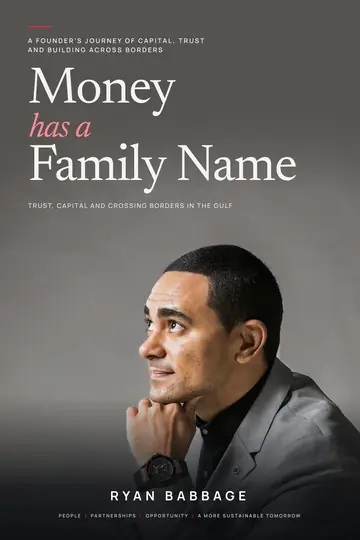
Founderand commercial strategist, writing on how value is created, protected and passed on
5 capitalsdecide whether what you build will last
15 statementsa free self-review of where the five capitals stand
Ryan Babbage · Founder and Commercial Strategist
Scroll
Wealth is not only built.It is kept, governed and passed on.And most of it is lost in the passing.
The Five Capitals of a Family Name
The Five Capitals
The question is never “how much capital do we have?” It is “which capital needs attention first, and what is it costing the others?”
01 / 05
Financial capital
Is the money structured to survive the next generation, the next cycle and the next deal?
Signs of strength
Clear ownership. Liquidity matched to obligations. Family money and business money kept apart.
Warning signs
Wealth concentrated in one asset. Informal loans. No plan for the day the money moves.
02 / 05
Enterprise capital
Is the business worth owning, and could it be bought, merged, grown or handed on?
Signs of strength
A clear strategy. Management beyond the founder. Assets that are owned, evidenced and documented.
Warning signs
Value locked inside one person. A business only the founder can run.
03 / 05
Human capital
Are the next leaders ready, and are the roles and expectations clear?
Signs of strength
Development plans. Clear roles for family inside and outside the business. Independent voices at the table.
Warning signs
Succession assumed, not prepared. Heirs unsure of what is expected of them.
04 / 05
Reputation capital
What does the family name stand for in the market, and is it an asset or a risk?
Signs of strength
A name that opens doors. Consistent conduct. Relationships held by the institution, not only the founder.
Warning signs
A name tied to one person. Trust that has never been tested.
05 / 05
Decision capital
How are big decisions made, by whom, and how quickly?
Signs of strength
Agreed forums and rules. Decisions made on time. Disagreement handled inside a structure.
Warning signs
Deferral. One person decides everything. The most important questions are never put on the table.
Decision capital is the keystone. The other four are assets; this is the ability to use them. Waiting looks costless. It never is: the bill is simply posted forward, and it grows while it waits.
Every capital can be described on the same simple scale of what you could point to today. It gives a family, a founder and a board one shared language.
Not yet established
Not yet addressed, or no working arrangement anyone could point to.
Informal or developing
Some practice exists, mostly through goodwill and habit. Little is written down.
Defined and in use
A defined approach is understood and used in practice.
Used and reviewed
Used in practice and reviewed when circumstances change, so the next generation could run it and improve it.
Ways in
Start with an idea. Stay for the conversation.
Every step uses the same five capitals, so the language you learn in the book is the language we use in the room.
Four questions every board should be able to answer.
Free self-reviews for owners and leadership teams: priority issues first, a profile of typical practice and one practical next step. Your answers are processed in this browser and not stored or transmitted.